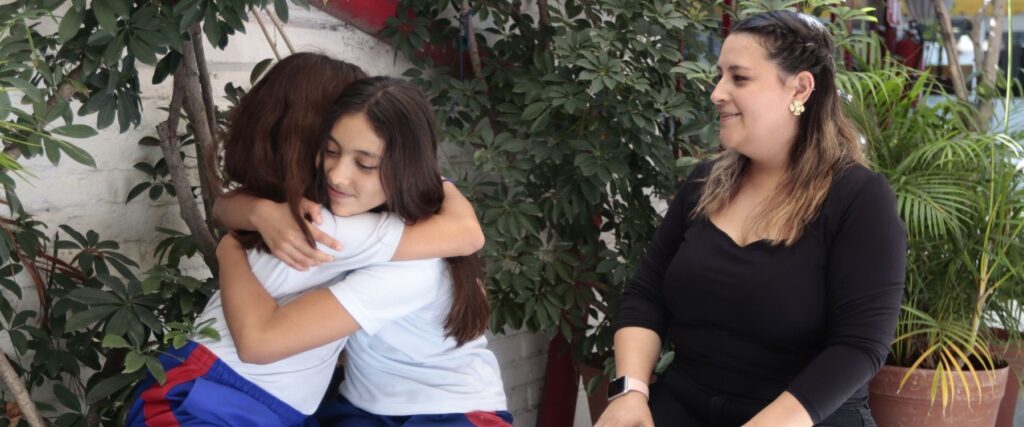
At the Erik Erikson School, one of the pillars of the methodology is the emotional and social development of the children. Promoted through the enhancement of key competencies ranging from emotional self-awareness and companionship to participation and the development of critical thinking and conflict management from a cognitive-emotional and social approach. We know that emotions and behavior are influenced by several factors, some of which refer to the interpretation of events, expectations, and the use of language we use to describe what is happening, what we feel and want. That is why social and emotional formation is immersed in the school culture, which is visualized in everything we do; from the style of interaction we have with students and parents and the participation of teachers in the classroom and at recess, as well as in the feedback dialogues with students for inconvenient behaviors, whether group or individual, as well as in the specific activities that students experience in an emotional intelligence workshop that is taught from first through sixth grade.
The emphasis is on the complexity of interactions between children and with close adults. It begins with observation of other children and progresses to play and collaborative work, enhancing companionship and collaborative play with two or more children where they contribute or incorporate ideas from others. The culminating point is for students to be able to take autonomous actions that benefit the school community and their immediate environment, recognizing how their behavior can affect others. So bullying is discouraged and unwelcome.
En el colegio Erik Erikson, uno de los pilares de la metodología es el desarrollo emocional y social de los niños. Se promueve mediante la mejora de competencias clave que abarcan desde el autoconocimiento emocional y el compañerismo hasta la participación y el desarrollo del pensamiento crítico y el manejo de conflictos desde un enfoque cognitivo-emocional y social. Sabemos que las emociones y la conducta están influidas por varios factores, algunos se refieren a la interpretación de los eventos, de las expectativas y del uso del lenguaje que usamos para describir lo que sucede, lo que sentimos y queremos. Es por ello que la formación social y emocional está inmersa en la cultura del colegio, la cual se visualiza en todo lo que hacemos; desde el estilo de interacción que tenemos con los alumnos y los padres de familia y la participación de los maestros dentro del salón y en el recreo, así como en los diálogos de retroalimentación con los alumnos por conductas inconvenientes, ya sean grupales o individuales, así como en las actividades específicas que viven los alumnos en un taller de inteligencia emocional que se cursa desde primero hasta sexto de primaria..
El énfasis se pone en la complejidad de las interacciones entre los niños y con los adultos cercanos. Comienza con la observación de otros niños y avanza hacia el juego y trabajo colaborativo, potencializando el compañerismo y el juego en colaboración con dos o más niños donde se contribuyen o incorporan ideas de otros. El punto culminante es que los alumnos puedan realizar acciones autónomas que beneficien a la comunidad escolar y a su entorno más cercano, reconociendo cómo su comportamiento puede afectar a los demás. De tal manera que el acoso escolar es desalentado y no es bienvenido.
In social conflict management, there is an approach that focuses on the progression of the child’s ability to handle disagreements. It begins with counseling to understand and manage initial reactions that are inconvenient for the child and to encourage them to ask for help from the adult to manage the conflicts that arise until they reach the goal of learning to set limits and being able to independently negotiate a solution to a conflict with another child. Finally, the child should be able to anticipate whether a solution will work and participate in mediating conflicts between other children.
In summary, we describe socioemotional development as a holistic and hierarchical holistic and hierarchical process where children move from the simple expression of feelings and needs to the complex management of their own emotions and the active management of social interactions, collaboration, and mediation within a community group.
The emphasis on social-emotional development is like a bridge-building plan: it begins by securing the internal foundation (management of Emotional and cognitive development), then extending the support structures to authority figures (Adult relationships), and finally, it enables the building of complex two-way pathways with peers (Relationships with other children and Conflict Resolution) to ensure that the school social structure (Community) remains strong and cooperative.
The following is Pedro’s case, which happened a few years ago at the school and is about how a conflict could be used to resolve it and turn it into a group learning experience.